

All around the world, people are talking about (often quite nervously) data centers. It’s common for an area’s residents to be concerned about ANY new development; we learned about this all too well when getting involved in local politics. New apartment complex? THIS IS HORRIBLE, BLOCK IT! Shifting land use to allow for agricultural production? THIS IS HORRIBLE, BLOCK IT! Office park? Rehab center? Mall? THESE ARE HORRIBLE, BLOCK THEM!
You get the picture. It should therefore come as no surprise that anywhere in the world where a data center is proposed, local NIMBY residents will march forth, clutching their pearls.
What is surprising is the highly-funded support US-based data center resisters receive, often launder—er—hosted by organizations not related to AI hazard reduction or the climate-related concerns around data centers, such as the NAACP. We explore it (as well as the impact data centers have vis a vis other industrial developments like farms, power plants, factories, etc.) in this special weekend episode.
Show Notes
Americans are being manipulated about data centers and it’s working.
In May, Gallup reported that “Seven in 10 Americans oppose constructing data centers for artificial intelligence in their local area, including nearly half, 48%, who are strongly opposed. Barely a quarter favor these projects, with 7% strongly in favor.”
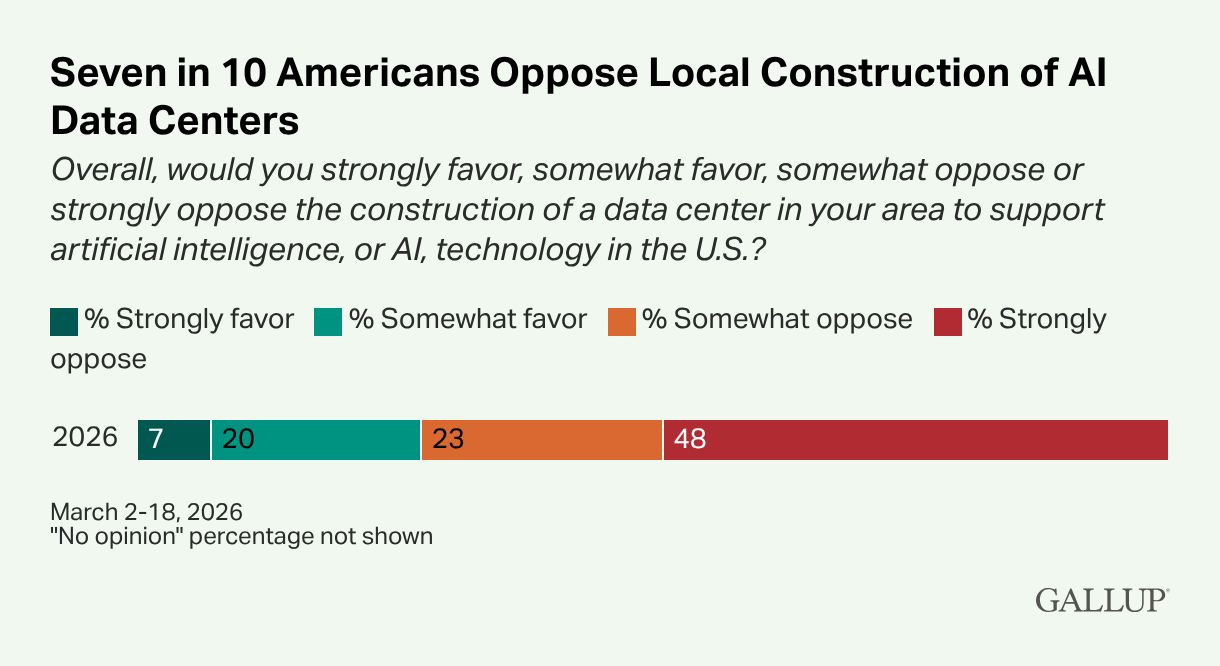
This fear is NOT universal: US residents show notably higher and more intense opposition to local data centers (especially AI-related ones) compared to available polling in Europe and elsewhere.
The Washington Post says the various orgs reporting foreign influence (it names several) don’t provide specific proof—and THEY DON’T.
But when you look at the difference between data center resistance in the USA versus Europe, Asia, and the rest of the world, things don’t quite add up. There are, I would argue, clear signs of astroturfing.
Namely:
1. Heavy resistance in the USA (vs. in other places)
2. Which has sharply increased
3. Which is heavily funded, often by foreign actors
4, Which—and this is where I begin to speculate—might be CCP-associated, but if so, is well laundered (probably through environmental and racial justice organizations)
We’re going to explore those warning signs, plus explore the impact this anti-data-center advocacy has had and what the actual facts are vis a vis data center damage (versus damage from any other form of factory, plant, farm, etc.).
Signs of Astroturfing
Sharp Increase
Per Change Research (April 2026, n=2,702 registered voters): National support for data centers dropped to ~36% (53% opposed). Local/community support even lower (~25–26% support vs. 65% oppose). Sharp rise in opposition since 2025.
Extra Fear in the USA
Is there a similar level of resistance (protests, rallies, threats, anti-data-center group formation, etc) around data centers in countries outside the US, for example in Europe or Asia?
TL:DR:
In Europe, there’s resistance but it’s less intense (it tends to involve fewer rallies and protests and more regulatory pauses, planning rejections, project cancellations, and only very occasional threats and violence).
In Asia and other regions, it’s fairly uncommon and unrest that does arise is grassroots and in response to actual local water/energy strain (see more on this from the NY Times)
Asia and Other Regions
Malaysia (per the South China Morning Post): First public protests in early 2026 against rapid buildout (driven by AI demand and spillover from Singapore). Concerns over power/water strain, land conversion (e.g., palm oil estates), and environmental/health impacts. Government has restricted non-AI data centers and tightened approvals.
Chile: Community activism (e.g., Mosacat group in Cerrillos/Santiago) successfully blocked a Google project over water use in arid areas. Broader concerns about aquifer depletion.
Other areas mentioned in the NY Times: Concerns or pushback in Singapore (past moratoriums lifted with green rules), India, Brazil, and Uruguay, often tied to water/energy in vulnerable areas.
European Resistance
Netherlands: Strong pushback, especially from farmers and residents. Local opposition derailed Meta’s massive Zeewolde project over environmental (nitrogen) impacts, farmland loss, and resource use. Groups like Save the Wieringermeer have campaigned against Microsoft and others in areas like the Wieringermeer polder, citing water/electricity strain. Temporary national restrictions or halts on mega-projects have occurred.
Ireland: Data centers already consume >20% of national electricity (higher in Dublin area). Campaigns by groups like Not Here Not Anywhere (NHNA) and Friends of the Earth led to a de-facto freeze on new connections around Dublin (extended to at least 2028) due to grid strain. Protests and calls for moratoriums are ongoing.
Spain (e.g., Aragón, Talavera de la Reina): Activists with Tu Nube Seca Mi Río (”Your Cloud is Drying My River”) protest water use in drought-prone regions, where facilities like Amazon/Microsoft projects draw heavily from local supplies. Residents call areas “sacrifice zones.”
France (e.g., Marseille): Groups like La Quadrature du Net oppose urban data centers, arguing energy should prioritize public needs. Activism includes street campaigns highlighting takeover of buildings and resource diversion.
Other areas: Opposition in Germany (e.g., Frankfurt), UK, and broader EU discussions over energy efficiency. Local groups have sprung up continent-wide; some projects face delays or cancellations, but overall capacity is still expanding under EU digital sovereignty goals.
Heavy Funding in the USA
Where is USA-Based Resistance Coming From?
Environmental nonprofits / racial justice groups
NIMBYs
“Advocacy groups”
Both the environmental nonprofits and racial justice groups are fishy, as are the dedicated advocacy groups.
What’s fishy about the advocacy groups?
Dedicated anti-AI orgs (either standalone or within larger nonprofits) are not as common outside the US as they are in the US.
Data center resistance outside the US is a NIMBY thing.
Opposition is generally more fragmented, local, and integrated into broader environmental/climate work rather than featuring many standalone “anti-data-center” organizations with heavy external funding.
WHICH IS WHAT YOU WOULD EXPECT FROM GRASSROOTS ACTION
These efforts often succeed via permitting, grid rules, or environmental assessments rather than mass coordinated advocacy.
Dozens of dedicated local coalitions, national coordination such as NAACP’s Stop Dirty Data Centers campaign, the Data Center Reform Coalition, and the Athena Coalition
There are documented flows of tens of millions in philanthropic support (often foreign-sourced via foundations like Wyss, Oak, Quadrature, KR, etc.) to environmental and justice-oriented groups amplifying the issue. This includes playbooks, legal templates, multi-state letters (e.g., 230+ groups calling for moratoriums), and scaling of local actions.
Examples of External Funding of Advocacy Groups
Reports (e.g., from American Energy Institute, citing tax filings/990s and grant databases) claim that 12 organizations actively opposing data centers have received over $39 million from foreign donors/foundations.
Key sources include:
The KR Foundation
Danish
No documented China links
Hansjörg Wyss (via Wyss Foundation/Berger Action Fund)
Swiss billionaire
Made his money from a medical device company, Synthesis, sold to Johnson & Johnson; criticized for foreign influence but not CCP-directed influence
UK-based entities like the following
The Quadrature Climate Foundation
No direct CCP ties
Oak Foundation
Indirect China engagement (they’ve supported initiatives to “green” China’s Belt and Road Initiative via groups like Climate Works and WWF, which critics argue empower CCP infrastructure and CCP soft power projection
Chris Hohn
Hedge fund manager
His hedge fund, TCI, funds CIFF, a registered NGO in China which has a Beijing office and collaborates with CCP officials on climate policy and supports green Belt and Road Initiative development.
He has leadership ties in CHina, such as CEO awards in China, roles in China-linked coalitions
See: Foreign Charities Fueling Extreme Policies in the U.S. by Americans for Public Trust
NOTE:
These funds commonly flow to broader environmental/climate groups (e.g., Sierra Club, Food & Water Watch, Earthjustice, Southern Environmental Law Center) that have incorporated data center opposition into their work.
No strong, direct evidence links any of these organizations or individuals to CCP-related income sources or primary funding.
In all the investigation into foreign backing presented by opposition groups, there are only very limited mentions of China-linked networks (e.g., via Neville Roy Singham funding groups like CodePink) overlapping with data center protests. These associations are more tangential and less verified for this specific issue.
The More Questionable Groups
National groups and coalitions:
Organizations like the NAACP (Stop Dirty Data Centers campaign), Piedmont Environmental Council, and Data Center Reform Coalition coordinate across states.
They receive support from pass-through funders like the New Venture Fund and Sixteen Thirty Fund, which have taken millions from pro-environmental donors.
These groups provide playbooks, legal templates, and strategy for local actions.
Are CCP-associated figures laundering China’s involvement by donating to environmental nonprofits and other nonprofits for but stipulating that the donation should be anti-data-center action?
If they’re doing it right, we won’t know, but the unusual nature of opposition in the US (all the extra funding, the dedicated orgs (or sub orgs), and the spike in sentiment change suggests smoke, so I’m looking for fire.
The strongest CCP-adjacent link is with the Neville Roy Singham network (the strongest CCP-adjacent link):
Singham, a U.S.-born billionaire now based in Shanghai with documented ties to Chinese state media and Maoist sympathies, has funneled ~$278–285 million into U.S. nonprofits (e.g., CodePink, Party for Socialism and Liberation/PSL, Tricontinental) via donor-advised funds and shells.
These groups have actively opposed U.S. AI/data center projects (e.g., circulating videos against Utah projects, broader protests). They coordinate messaging with CCP state media (CGTN, China Daily, Global Times), which amplifies anti-data-center narratives on energy/water use while China subsidizes its own AI buildout.
Reports (Bitcoin Policy Institute, Fox News, congressional inquiries) describe this as influence operations aligning with CCP goals to slow U.S. AI infrastructure. Singham’s network produces domestic content opposing U.S. AI that parallels Beijing’s propaganda.
However, funding is generally for broad ideological causes (socialism, anti-imperialism, climate justice) rather than narrowly earmarked “anti-data-center only.” Data center opposition appears as one tactic within larger activism.
Laundering support for data center opposition through US nonprofits would be in line with broader CCP tactics:
Using Chinese state media to directly push anti-U.S. data center stories to American audiences.
Exerting Indirect influence via aligned nonprofits, United Front-style networks, or Energy Foundation China (ties to CCP ministries) on climate issues more generally.
Broadly engaging in “political warfare” or influence ops to hinder U.S. strategic advantages (AI race), as alleged in reports urging congressional probes.
CCP-backing or no, what is this resistance yielding?
USA-Based Data Center Resistance
Protests & Attacks on US-Based Data Centers or Data Center Initiatives
Reports indicate at least 142 activist groups across 24+ states, with $18 billion in projects blocked and $46 billion delayed in recent years (per Data Center Watch).
Many protests occur at town halls, planning meetings, rallies, and occasionally involve direct action like blockades.
Examples of Attacks
Virginia (e.g., Prince William County - Digital Gateway project)
Major protests against a proposed massive 22-million-square-foot complex (up to 37 data centers) near Manassas National Battlefield Park.
Residents rallied multiple times
Lawsuits led to a 2026 Virginia Court of Appeals ruling invalidating rezoning, effectively halting it (subject to further appeal).
Concerns included traffic, noise, historical preservation, and grid strain.
Memphis, Tennessee (xAI Colossus supercomputer/data center)
Ongoing protests, including a May 2026 “die-in” and driveway blockade by groups like Tigers Against Pollution (uni students) and Memphis Community Against Pollution.
Residents (often in majority-Black neighborhoods) cite air pollution from gas turbines, lack of permits, and health impacts.
NAACP and others have sued over Clean Air Act violations.
Protests involve rallies, sit-ins, and legal action.
Michigan (e.g., Saline Township - Stargate project)
Rallies against a proposed $7 billion data center on farmland, including a large gathering at the state Capitol in December 2025.
Concerns focus on farmland loss, water/power use, and lack of transparency.
Indiana (e.g., Indianapolis, Chesterton, other areas)
Widespread protests and meetings against multiple projects.
In Chesterton, a $1.3 billion proposal was withdrawn due to opposition.
Residents protest at hearings over noise, industrialization of neighborhoods, and utilities.
Arizona (e.g., Goodyear/Buckeye, Tucson - Project Blue)
Large projects blocked or withdrawn after resident pushback at meetings over water use in desert areas, building height, noise, and resources.
Tucson council unanimously dropped discussions in 2025 amid public outcry.
A $1.5 billion Harper Road Technology Park proposal blocked after protests over visual/noise impact and property values
Zoning was amended to prohibit data centers.
Protests or successful blocks/delays in Pennsylvania, North Carolina, New Jersey, Oklahoma (e.g., Coweta County - Project Sail petitions), Texas (e.g., Waco, San Marcos), California (e.g., Monterey Park ban), Wisconsin (ballot measures), Utah (referendum efforts), and more. Petitions, moratoria, and local ordinances are common tools.
Attacks on AI Leaders
Sam Atlman
A Molotov cocktail was thrown at OpenAI CEO Sam Altman’s home
Then, around 5:07 a.m. [Pacific Time], San Francisco police officers responded to a business on the 1400 block of 3rd Street “regarding an unknown male subject threatening to burn down the building.” (OpenAI’s headquarters are at 1455 3rd Street.) (per NBC News)
Attacks/Threats Against Data Center Developers
MarketWise reported on threats against data center developers/employees in places like Illinois.
Attacks on Politicians
Indianapolis councilman says shots fired at home and ‘No Data Centers’ note left at door
Indianapolis councilman Ron Gibson and his 8-year-old son were woken up by the sound of someone firing 13 shots at the front door of their home
The shooter left a note reading “No Data Centers”
Police believe it was a targeted incident linked to local controversy over a newly approved data center project in his district.
US Governmental Response
The US government’s response is pretty disappointing. So far, they’re mostly like… just protecting themselves?
From the US Congress’ intelligence bureau
Following Jan 6, 2021, Capitol Police Chief Thomas Manger created a new intelligence bureau to monitor and respond to rising threats against members of Congress nationwide, especially via social media and other digital channels. (Politico reports on this)
Capitol Police argue (surprise surprise) that threats have sharply increased over the past decade and that the bureau now actively gathers Capitol-specific intelligence in coordination with other agencies to function like a “Secret Service” for Congress around the clock.
A leaked internal intelligence report by the U.S. Capitol Police’s Intelligence Services Bureau (published by Ken Klippenstein on Substack) about supposed threats linked to opposition to data centers, especially AI-related ones reveals the Intelligence Services Bureau is monitoring social media content critical of data centers, looking for potential threats.
The note states that “The US Capitol Police is not investigating any data center‑motivated threats to Members of Congress” as of the date of the document, while acknowledging that related policies on the Hill and locally are likely to continue drawing opposition and thus raise concern.
Long story short, the USCP ISB is:
Tracking and analyzing violent incidents, online rhetoric, and ideological calls for attacks tied to data centers and AI (e.g., the Indianapolis shooting, online calls to assassinate local officials, extremist statements about killing AI CEOs, and the incidents at Sam Altman’s residence).
Producing finished intelligence for internal law‑enforcement audiences so that protection details, investigators, and partner agencies understand emerging motives and potential targeting patterns involving public officials and AI/data‑center industry figures.
Maintaining an open‑source and threat‑stream watch on anti‑AI/data‑center sentiment, with an explicit commitment to update stakeholders as the threat picture evolves.
What the document does not do is spell out any new protective operations, staffing changes, or explicit policy shifts beyond this intelligence‑production and monitoring function; those would typically appear in separate operational or policy directives rather than in an intelligence note.
Data Center Concerns: Are They Justified?
Concerns center around massive electricity and water consumption, noise, land use, visual impact, property values, tax incentives, and environmental/health effects.
Well, at least the concerns are real
Per the WSJ article on the recent Gallup poll I mentioned at the top: “The poll found that both Republicans and Democrats are uncomfortable living near a data center, but opposition is especially intense among Democrats. Fifty-six percent of Democrats strongly oppose a data center in their community compared with 39 percent of Republicans. Nearly half of independents also said they were strongly opposed to the projects.”
It’s rare to have so much bipartisan unity on something!
They continue: “Gallup’s poll closely matches several other recent polls including a Washington Post-Schar School survey of Virginia voters in April. That poll found that 59 percent of respondents oppose the location of a data center in their area, a dramatic reversal from a 2023 poll that showed fewer than 1 in 4 Virginia voters held that view.”
Focus seems to be on water usage: “The survey showed that 70 percent of the 1,000 Americans polled worry about data centers’ environmental impacts. About half of opponents specifically mentioned they were worried about an excessive use of resources such as water. About 1 in 5 opponents are also concerned about the impact on local quality of life, while similar numbers worry that data centers could drive up utility bills.”
Also the concerns are translating to action
Again, per WSJ: “In response to public pressure, lawmakers in several communities have imposed moratoriums on large data centers. The issue has also risen to a top concern for voters. In some communities, local officials who supported the construction of data centers are being voted out of office.”
BUT ARE THEY JUSTIFIED???
How does the electricity and water consumption, noise, land use, visual impact, property values, tax incentives, and environmental/health effects of data centers compare to that of other commercial constructions, including farms, processing plants, electricity generating plants, and factories?
TL:DR: Data centers really are huge energy hogs, and it seems ill-informed to place them anywhere where there’s a shortage of water (like, in the ocean seems great), but otherwise they’re roughly no worse than other forms of industrial development (e.g. farms, factories, plants), and it’s important to emphasize that there are ways around the top three issues: land use, water, and electricity.
Especially with ocean-based data centers:
China launched the world’s first commercial-scale, offshore wind-powered underwater data center off the coast of Shanghai. The facility connects to mainland networks just 10 km away. Highlander Digital Technology, the primary developer, also operates an earlier pilot phase near Hainan Island.
Though—SURPRISE SURPRISE—these projects are highly scrutinized by environmental regulators.
Electricity Consumption
ACTUALLY WORSE: Per a report put out by the US Congress, data centers are outliers in power density and growth rate.
Data centers: Extremely high and concentrated. A conventional facility uses power equivalent to 10,000–25,000 households; AI hyperscale ones can match 100,000+ homes or more (e.g., some Meta projects rival entire cities). U.S. data centers consumed ~4.4% of national electricity in 2023, with projections of doubling/tripling by 2028–2030. They drive new power plant builds and grid upgrades. (WRI)
Comparisons:
Power plants: They generate electricity (often for data centers), so their own consumption is operational but supports massive output.
Factories/manufacturing: High but typically lower per footprint than hyperscale data centers; varies by industry (e.g., semiconductors are energy-intensive).
Farms/processing plants: Much lower direct electricity use; irrigation pumps and processing add some load, but not at data center scale.
IMPORTANT: There are ways around this
Change regulation around small-scale nuclear power
Water Consumption
NOT EXACTLY WORSE: Data centers compete locally with other users in stressed areas.
Data centers: High for cooling (evaporative systems). Mid-sized: up to 300,000 gallons/day; large: up to 5 million gallons/day (equivalent to a small city). U.S. total is notable locally (e.g., Texas projections: 49 billion gallons in 2025). Indirect use via fossil power plants adds significantly. (Per the World Resources Institute)
Comparisons:
Farms/agriculture: Dominates U.S. water use (often 70–80%+ nationally); one alfalfa field can exceed a data center per acre, but spread out. Data centers are more concentrated.
Power plants: Often higher indirect cooling water use than data centers’ direct use.
Factories/processing plants: Varies; food processing or chemical plants can be water-intensive but generally less per facility than large data centers.
IMPORTANT: There are ways around this
Put data centers in the ocean (and eventually in space)
Land Use
MIXED: Less picturesque than farms, less compact than processing plants, similar to power plants
Data centers: Large footprints (average ~224 acres, up 144% since 2022; hyperscale campuses >1,000 acres) plus transmission lines. Often on former farmland or greenfield sites.
Comparisons:
Farms: Vast total land but productive/use-intensive.
Factories/power plants: Factories often smaller per output; power plants (especially renewables) can span large areas.
Processing plants: More compact.
Data centers convert land to low-employment, impermeable use with limited future flexibility.
IMPORTANT, again there are ways around this
Build data centers in the ocean or space
Property Value
PROBABLY NOT ANY WORSE THAN ANY OTHER PLANT/FACTORY/FARM
Some studies (e.g., Northern Virginia) show homes closer to data centers sell for higher prices (due to economic activity, infrastructure). Others report buyer hesitation over noise/traffic/visuals, potentially depressing values in residential-adjacent areas. (See more in this House Beautiful article)
Noise
NOT AS BAD: It’s similar to normal factories and power plants and lower than farms
Data centers: Significant from cooling fans, chillers, and backup diesel/gas generators (up to 85–100+ dB, audible far away). Continuous operation leads to frequent complaints. (per the Environmental and Energy Study Institute)
Comparisons:
Factories/processing plants: Similar industrial noise levels; often regulated similarly.
Power plants: Comparable or higher from turbines/generators.
Farms: Lower (machinery seasonal); processing plants can be noisy.
Environmental/Health Effects
NOT AS BAD: Though concentrated and growing fast, data centers are “cleaner” than fossil-heavy industry
Data centers: Low direct emissions if renewably powered, but backup generators cause air pollution (linked to premature deaths, asthma). Noise and water strain are key issues. Health cost estimates for some projects: tens to hundreds of millions annually.
Comparisons:
Power plants/factories: Often higher ongoing emissions/pollution.
Farms/processing: Pesticides, runoff, odors, methane; animal agriculture dwarfs data centers in total water/emissions.


