

The internet has fundamentally changed — and almost no one has noticed. In this episode of Based Camp, Malcolm and Simone Collins break down how the explosion of global internet users (especially from India, Pakistan, Indonesia, Brazil, Bangladesh, Nigeria, and other developing nations) has dramatically reshaped online discourse on both the left and the right.
They explore:
Why environmentalism, anti-Black racism, and anti-Hispanic racism faded from leftist priorities while Gaza, Pakistan, Jews, and “Hindu Indians” suddenly dominate
Audience capture, botting, and engagement farming
Why certain right-wing creators (Tucker Carlson, Nick Fuentes, Andrew Tate) shifted toward international/Islamic audiences
The hidden influence of third-world users on Western political conversation
Christian-majority vs. non-Western audience patterns
And why the “online right” often feels disconnected from actual American conservatives
A paradigm-shifting look at how the internet is no longer majority American — and what that means for culture, politics, and influence.
Show Notes
In terms of sheer internet users (using broadband and mobile internet subscriptions as a proxy), there is only one Western nation—the USA—represented in the top ten countries represented
(top representation = China, India, theU SA, Indonesia, Brasil, Russia, Japan, the Philippines, Bangladesh, and Pakistan).
Contrast this to 2008, when the top users of the internet were:
China (but doesn’t count, due to the great firewall of China)
And then the USA, Japan, Germany, the UK, France, and Brazil
In terms of broadband: Leading countries by total subscribers or penetration included the US, China, Japan, South Korea, Germany, France, UK, and Canada.
So functionally: Mostly Western nations were represented online
Could this be why the left shifted from discourse about LGBT and climate change to discourse about Palestine?
Internet + Broadband Subscriptions: Then and Now
Internet/Broadband Subscriptions in 2008
Leading countries by total subscribers or penetration included the US, China, Japan, South Korea, Germany, France, UK, and Canada.
Mobile + Broadband:
China: ~253 million (June/July 2008; some estimates ~180–220 million by end-2008). China surpassed the US mid-year.
United States: ~220–230 million (active/home users ~150 million in early 2008 per Nielsen).
Japan: ~80–90+ million (active home users ~47–48 million in early 2008).
Germany: ~40–50+ million (active home ~35 million).
UK, France, Brazil, etc.: Lower but still in the top tier (e.g., UK/France ~25 million active home users; Brazil growing rapidly).
Internet/Broadband Subscriptions Today
Dominated by:
China
India
USA
Indonesia
Brazil
Russia
Japan
The Philippines
Bangladesh
Pakistan
The USA is the only “western” country represented on the top ten list.
Pulling from Wikipedia’s list of sovereign states by number of broadband Internet subscriptions, I combined mobile + broadband internet subscriptions to create a ranked list:
China - 1852637000
India - 1200170910
United States - 505719000
Indonesia - 464967914
Brazil - 265158564
Russian Federation - 258214661
Japan - 210519139
Philippines - 176599291
Bangladesh - 152409669
Pakistan - 146355310
Nigeria - 144994174
Germany - 139217000
Mexico - 131458662
Vietnam - 131286117
Thailand - 129738000
Egypt - 108181505
United Kingdom - 105189476
Italy - 100457919
France - 97446000
Iran - 97164277
South Africa - 93576635
Turkey - 89725075
South Korea - 84854606
Argentina - 69767601
Colombia - 68540947
Spain - 66958543
Ethiopia - 63197120
Ukraine - 60954476
Poland - 56881929
Algeria - 53040296
Myanmar - 48356160
Canada - 45381104
Morocco - 45294933
Malaysia - 45026300
Kenya - 43103412
Saudi Arabia - 42709657
Tanzania - 41802027
Peru - 41225603
Ghana - 36808571
Nepal - 36096396
Australia - 35476000
Democratic Republic of the Congo - 35271156
Taiwan - 34490976
Iraq - 33335316
Côte d’Ivoire - 31890058
Sri Lanka - 29419587
Kazakhstan - 29046500
Sudan - 28675221
Netherlands - 27742800
Uzbekistan - 27585670
Romania - 27330000
Venezuela - 27103805
Chile - 26072126
Uganda - 25094643
Afghanistan - 23946523
Hong Kong - 20986099
Guatemala - 19986482
United Arab Emirates - 19826224
Cameroon - 19748144
Cambodia - 18702623
Burkina Faso - 17960442
Austria - 17435540
Syrian Arab Republic - 16804909
Greece - 16715369
Belgium - 16340062
Sweden - 16171593
Senegal - 15870161
Czech Republic - 15695534
Ecuador - 15565345
Portugal - 15338153
Switzerland - 15142000
Tunisia - 15135865
Hungary - 14987525
Belarus - 14578427
Zimbabwe - 14279414
Zambia - 13474451
Angola - 13420871
Israel - 12882000
Azerbaijan - 11932214
Mozambique - 11917159
Bolivia - 11321904
El Salvador - 10424913
Bulgaria - 10297690
Serbia - 10101873
Singapore - 9933200
Costa Rica - 9584401
Dominican Republic - 9555585
Denmark - 9453730
Finland - 9017200
Rwanda - 8840997
Benin - 8801877
Niger - 8787534
Madagascar - 8755561
Slovakia - 8522504
Honduras - 8466489
Nicaragua - 8390000
New Zealand - 7982000
Norway - 7855360
Malawi - 7781723
Follower Composition of Major Influencers
Nick Fuentes - America First?
The Network Contagion Research Institute reported (in December 2025) that ~50% of retweets on Nick Fuentes most viral posts originated from foreign accounts before Kirk’s death.
These were heavily concentrated in countries like India, Pakistan, Nigeria, Malaysia, and Indonesia (with additional shares from the UK and Canada among foreign sources). Non-Western countries made up the majority of the foreign retweets.
The NY Post reported that the pattern matched known engagement farm/bot activity (rapid, coordinated retweets shortly after posting, often from anonymous/single-purpose accounts), with no clear organic tie to Fuentes’ “America First” content in those regions.
Tucker Carlson - Pakistani Icon?
Tucker Carlson’s popularity among a Pakistani audience surged due to his outspoken criticism of liberal Western culture, his advocacy for Palestinian rights, and a viral 2025 interview where he stated he had more in common with a “sincerely religious Pakistani cab driver” than with secular, liberal Western elites
That said, Tucker Carlson Network (TCN) website traffic (as of early 2025 data) indicates:
~82% from the United States
~2.6% from Australia
~2.05% UK
~1.98 Canada
~1.67 Russia
No notable Pakistan or South Asian spike in the available breakdown.
On YouTube and X, independent estimates show moderate U.S.-heavy performance, with some international growth noted in the Middle East/Gulf due to his anti-war/anti-interventionist takes (e.g., on Iran), but nothing indicating dominance by Pakistan or similar countries.
Some X posts and memes joke about his audience shifting to “Pakistan, Iran, Russia” amid his criticism of U.S. foreign policy (especially on Iran). These are often mocking, not serious analysis (e.g., claims of “closeted gay Muslims in Pakistan” as his base or similar). Pakistani users sometimes push back, noting low actual awareness of him domestically
Andrew Tate: Indian Hustler?
Google search interest and anecdotal reporting (+ reporting form the Guardian) indicate higher per-capita interest in Muslim-majority countries (e.g., parts of the Middle East, Pakistan, Indonesia, Malaysia) than in the UK/US.
Popularity also noted in India, Brazil, and other Global South areas
Tate’s 2022 conversion to Islam boosted this
Much of Tate’s international reach comes from short-form content amplified by algorithms and affiliate promoters in places like India/Pakistan/Bangladesh
Audience composition often highlights young men from ethnic minority backgrounds in the West or aspiring youth in developing countries drawn to his “self-made” wealth, discipline, and anti-”matrix” messaging.
Hustler University
Articles note it helps young Indians navigate industry/job challenges; Indian students comment on applicability (e.g., freelancing); LinkedIn profiles and reviews show Indian participants. Affiliate promotion and clip-sharing by creators in India contribute to virality
Are Shifting Internet Audiences Changing the Discourse?
From a Based Camp listener: “A lot of their viewerbase are muslims, they don’t care about climate change. That is also why Tucker changed his content. American politics is now no longer only consumed by Americans. People from other countries also have strong opinions on US politics.”
To be fair, I checked Google Trends and Palestine has always (as long as they’ve been measuring search volume) been searched more than LGBTQ community stuff and climate change as a topic.
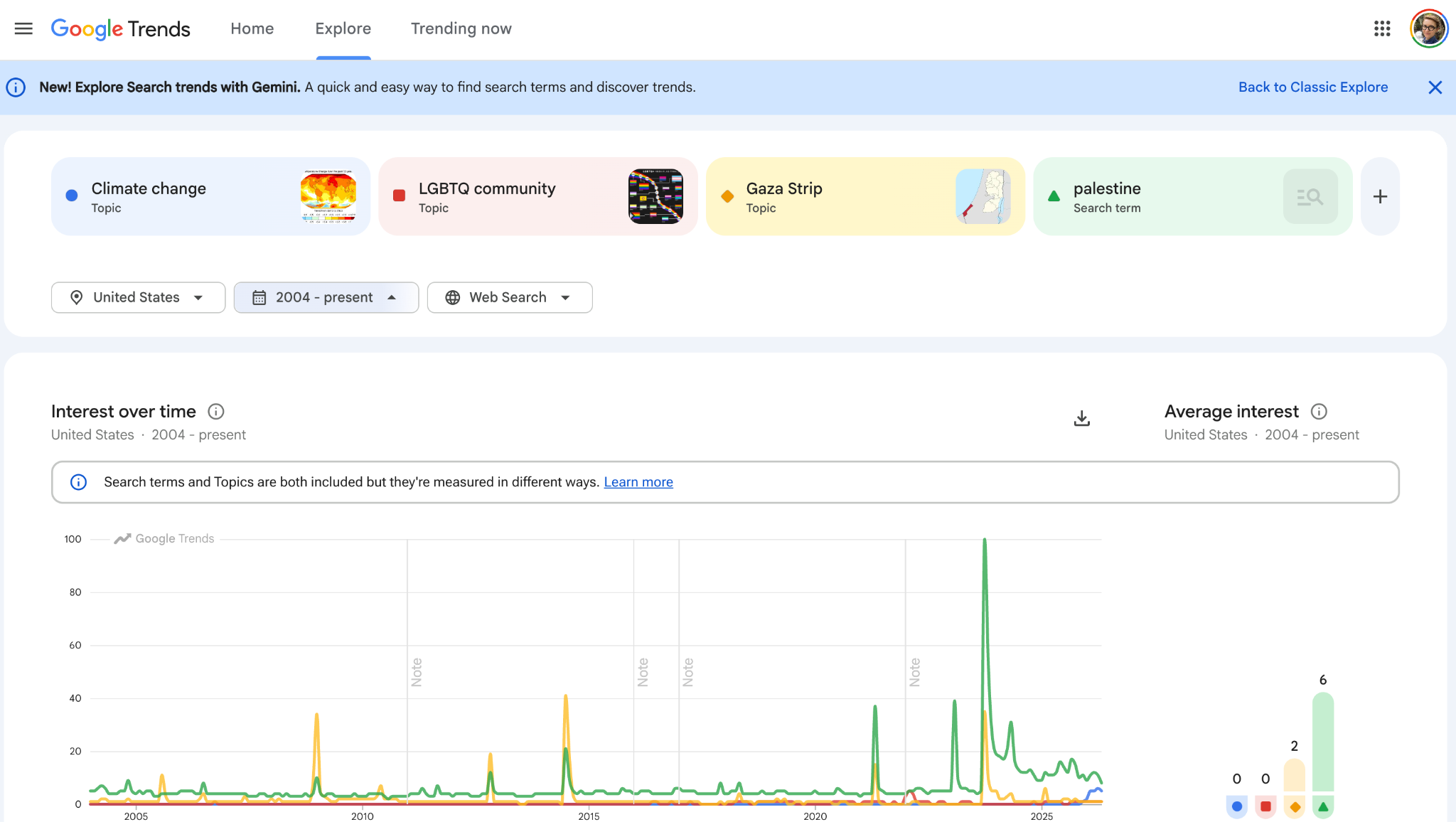
Why islamists and modern progressives are so compatible
The apparent alignment between Islamists (those advocating political Islam, often with Sharia-oriented goals) and progressives (or segments of the radical left) is a tactical “Red-Green alliance” driven primarily by shared enemies rather than shared values.
This is not a new alliance.
This phenomenon, sometimes called “Islamo-leftism,” has historical roots (e.g., Western leftists supporting Iran’s 1979 Revolution before many were purged) and has intensified in recent years, especially post-9/11, during anti-Iraq War protests, and after October 7, 2023 (The Free Press writes about it)
Core Reasons for the Alignment
Common adversaries: Both groups frequently oppose Western liberalism, capitalism, U.S. foreign policy, and Israel (viewed as a symbol of “imperialism” or colonialism). Progressives frame this through lenses of anti-racism, decolonization, and social justice; Islamists see it as a civilizational/religious struggle. This creates convergence on issues like Palestine, anti-Zionism (often overlapping with antisemitism critiques), and resistance to “Western hegemony.”
Identity politics and “oppressor vs. oppressed” framing: Many on the progressive left apply a hierarchy where Muslims (as a minority in the West or in conflict zones) are positioned as victims of colonialism/racism/Islamophobia. This leads to alliances via intersectionality, even when Islamist views on gender, sexuality, or secularism clash sharply with progressive ones. Islamists leverage this for legitimacy, funding, and platforms in Western institutions.
Anti-imperialism as a bridge: Historical leftist support for Third World revolutions extends to viewing Islamist resistance (e.g., Hamas, Hezbollah) as part of global anti-Western struggle. Shared tactics include protests, framing dissent as justice, and using media/activism to delegitimize opponents.
Pragmatic coalition-building: In the West, left-leaning parties see Muslim immigrant communities as electoral bases and prioritize anti-discrimination solidarity over cultural clashes. Islamists gain influence by adopting progressive rhetoric on equity while advancing their agenda.
Places where there’s tension but possibly even deeper alliance
Progressives typically champion secularism, LGBTQ+ rights, feminism, and individual autonomy.
Traditional Islamism emphasizes theocratic governance, strict moral codes (e.g., on homosexuality, apostasy, gender roles), and religious authority—views that conflict with core progressive tenets
Ironically, many conservatives (certainly us) see the modern left as being all about theocratic governance, strict moral codes, etc.
Episode Transcript
Malcolm Collins: [00:00:00] Hello, Simone. I’m excited to be here with you today. Today I am genuinely excited, because this theory has completely changed the way I see our society today.
This is one of the big ones. And- It is so explanatory to me of so many things that I didn’t have a good explanation for. For example, why did the left so quickly and over the very explicit time period that we are looking at completely abandon environmentalism? Why did they abandon anti-Black racism as a cause?
Why did they abandon anti-American Hispanic racism as a cause? Why did they start focusing on Gaza and, and Pakistan and the problem of Jews all of a sudden? Why all of a sudden did they start complaining about Hindi Indians all of the time? Why all of a sudden... not that there aren’t legitimate grievances here but these are changes that we’ve seen in both the left and the right.
So we’re gonna [00:01:00] talk about, like, where these changes have happened in both the left and the right. And I’m not saying, again, I’m not saying that these grievances don’t have, like, a genuine reason for them, right? But when I hear about, for example regularly, like, women being dragged off the streets in parks and graped, okay?
And then I see Nick Fuentes crashing out about Indian tech workers I’m like, “Your hierarchy of racism seems off.” Not, I’m not saying that, like... Or like the, the, the three boys of a certain ethnicity, you know, recently beat to death a, a disabled kid.
What? It’s three Black kids, yeah. There was a w- white disabled kid that they mocked and beat to death.
There was the, I think it was like they got, like,
Yeah, so they live-streamed themselves beating him over the course of three days, it looks like, and they only got re-respectively, , three years in prison, seven years in prison, and eight years in prison. That’s it
But I was wrong. He [00:02:00] survived, and so that is why people say, “Oh, it’s okay they got these relatively light sentences.”
Malcolm Collins: There was a recent incident of the Black guy, like, murdering some Asian old guy in San Francisco, and they said that putting him in jail would be bad for him.
Like, it would be bad for him, like, mentally or something, and so he’s not. No, it’s, it’s, g- there’s, like, a lot- And he’s just not using that
Simone Collins: i- if I ever get in trouble as a defense. This, this would be, this would be bad for me. Yeah, this would be bad for my emotional health- The timing is, it’s- ... if I got raped
I’ve got a lot going on right now. Yeah. Not a good time.
Speaker: For context, he murdered an 85-year-old Vietnamese immigrant and he was only given five years in prison, after which he was released. First he was only sentenced to eight years in prison, then he was released after only five years because it was considered bad for his mental health.
Malcolm Collins: Well, there was the recent incident of the the Muslim guy who drove into a crowd. Ooh. And they said it was a mental health issue, even though he said he just wanted to kill them all.
Simone Collins: Well, [00:03:00] at least there’s, you know, a long documented body of, of comments and analysis online talking about how unhinged we are.
We basically have an get out of jail free card.
Malcolm Collins: Exactly. Well, not anymore. Not that many people talk about how unhinged we are. Now most people are like, “Oh, they, they’re crazy, but they make a lot of points, and they’re barely ruthless.” That was your thing on Christmas. But okay, theory. Theory. We’re gonna get to the theory.
Yeah. Then we’ll talk about us. So, this was in a recent episode where we were looking at the expansion of internet users. Ooh. And we were going over data on this, Simone and I. And what happened over the past 10 years or so- ... is that the internet went from being predominantly an American and minoritely a European platform, to today being a much, much more international platform.
Yes. Where- In terms
Simone Collins: of sheer internet users, like we’re talking broadband and mobile internet subscriptions, there’s only one Western nation, the [00:04:00] USA, represented in the top 10 countries that are out there. So the top are China, which of course doesn’t count ‘cause they’re sort of walled off, India, the USA, Indonesia, Brazil, Russia, Japan, the Philippines, Bangladesh, and Pakistan.
We are the only Western country there. Whereas contrast that with 2008, and the top 10 internet users were China, but still doesn’t count, and then the USA, Japan, Germany, the UK, France, and Brazil. This is a very different landscape. It was mostly Western countries. We didn’t think... I mean, like it makes sense.
I don’t think this would come as a surprise to anyone, but I, I... What I don’t think we’re really thinking about is how that has impacted the discourse online and our perception of what, like- Simone, can you send me- ... people’s normal views are ... that list
Malcolm Collins: of countries?
Simone Collins: But you can actually, even if you go all the way to like 34, you’re like, “Oh my God,” like in terms of internet and broadband users today.
Malcolm Collins: And so what you’re going to notice is essentially what has happened to the internet over the past 10 years, [00:05:00] without people grokking that the internet has fundamentally changed, is the internet has become a platform where the majority of consumers, not the majority of creators, have become uneducated third worlders.
Mm-hmm. Sorry, I didn’t- Well, well- Savage third worlders ... people
Simone Collins: from, people from developing countries in, in many cases who may have-
Okay, yes,
Malcolm Collins: developing countries, people from developing cou- the developmentally challenged ... up and
Simone Collins: come, up and comers, and so- ... rising
Malcolm Collins: stars
Speaker 2: I found some video footage here that depicts their daily life
in a way that I think really humanizes them
Speaker 3: Attacker!
Malcolm Collins: What this has done is a lot of online content creators who get shaped by their audience have begun to drift [00:06:00] towards causes that the developmentally challenged, we’ll call them- Oh my God.
Thank you so much ...
prefer and champion. This explains perfectly why the left gave up on environmentalism. Does your random
Malcolm Collins: care about environmentalism? Does your random person from Bangladesh care about environmentalism? No. Will they tune in if you go on a rant about how much you hate Jews and Israel?
Of course, they’re Muslim majority countries. And this is what we’re seeing throughout the internet is we have gotten waves and waves and waves of potentially high attention spam, and we can even see this provably. If you look at a channel like Nick Fuentes, there was this thing where it came out that he was being rapidly retweeted after his tweets at a rate that was higher than even Elon, and when it came out where these were based, they were mostly in Muslim [00:07:00] majority countries like- Yes, I
Simone Collins: can br- I can, for those who want receipts the Network Contagion Research Institute reported in December of last year, 2025, that around 50% of retweets on Nick Fuentes’ most viral posts were originated from foreign accounts, though that was from before Charlie Kirk’s death.
And they were heavily concentrated in countries like India, Pakistan, Nigeria, Malaysia, and Indonesia, though there were some additional shares from the UK and Canada among foreign sources. It’s just- All of which- ... the important thing is that the majority were non-Western countries. And then additionally, the New York Post reported that the pattern matched known engagement farm bot activity, so it’s not just, like, natural interest in those- But, but hold on
non-Western countries. No, the point
Malcolm Collins: I’m making here- Yeah ... isn’t the point you’re making. I’m saying they might be wrong in this, okay? It might be genuine engagement from these countries. Every one of- Yeah ... the countries you mentioned has a large Muslim [00:08:00] population. The point I’m making is that across the internet, in both the left and the right, we have allowed ourselves to be heavily influenced by Muslim third worlders, basically.
And it’s caused a dramatic shift in the causes that the left claims to care about and the causes that the right cares about, and this shift has been exaggerated by a secondary issue which is something that we’ve been exploring in recent videos. But I have been digging deeper on, and it’s been completely changing my perspective of the right and the internet Which is the amount of large mainstream right-wing creators that are incredibly heavily botted and rely on incredibly heavy inauthentic viewer waves.
And as a result of this, people misunderstand two things. One is, who actually are the most influential [00:09:00] influencers in various intellectual spaces because they accidentally key to the bot farmed ones, not realizing that they don’t actually have that big of an authentic audience. And two, the people who are heavily botting because their proportional audience is so low, and if you are botting authentic, e- educated, you know, people from the United States are going to be less likely to go all the way through your streams.
The people who are actually still staying are more likely to be from these developing countries. And keep in mind, like, when we talk about the blatant developing country stuff, we’re not even talking about the ones who are using VPNs and stuff like that. Like, I bet the vast, vast majority of them are at this point, especially after the Twitter leak happened and it basically came out that a bunch of these people were just LARPing as conservatives and progressives and were actually all .
Malcolm Collins: I’m just gonna call them
Malcolm Collins: even though a lot of them are from India or from- Was it... Hold
Simone Collins: on ... Virginia. I have this vague memory of that word, that term being used in the movie Bend It Like Beckham, [00:10:00] and it was, like, seen as a major slur. Are we, is this part of the basement-
Simone Collins: a slur? If I’m remembering Bend It Like Beckham correctly, yes.
It was, it was yelled at her, muttered at her on the soccer field. It was deeply insulting and hurtful. Pakistanis. Okay. Yes. Thank you. Thank, thank, thank you. I mean, I was confused by it in the movie because I was like, it’s, it’s a reference to a, a shortening of your country name. You know, if someone called me a Yank I wouldn’t be- Yeah,
Malcolm Collins: it’s like Yank or something like that, right?
Like- But then keep in
Simone Collins: mind that, that... Oh, I the term Jap also was a slur. So- Oh, true ... I remember also, like, the shock I heard when I went to GWU in DC for my undergrad, George Washington University, and everyone kept talk- “Oh, she’s such a Jap. She’s such a Jap.” And I’m like like, “What’s... One, where are all the Japanese students, ‘cause I don’t see them?”[00:11:00]
Two, oh my God. But it turns out that they had never heard the term Jap because they were referring to Jewish American Princess, and there were a lot of very affluent Jewish students at my s- at my school. We
Malcolm Collins: gotta worry
Simone Collins: about those
Malcolm Collins: Japs taking over the, the- I mean, ... finance industry ...
Simone Collins: sl- slurs, slurs really confuse me.
I don’t know when I’m supposed to feel shocked and alarmed. There, there are, you know, sometimes multiple uses, so I’m just saying. I mean, it’s not a very biting slur if it is a slur. I, mm, I mean- I know, and neither is yank, and I don’t know. I mean, but like I think in the end, the problem with slurs is when they’re, when they’re said with, with anger and hate in one’s heart then suddenly they become bad and full of baggage, and then you can’t use them anymore.
Well, I
Malcolm Collins: should be clear. I mean this derogatorily. So I won’t use the term anymore. I will just call them Pakistanis. Ugh. For... And note, here, I’m not talking about everyone from Pakistan. Surely there are some intelligent people of [00:12:00] Pakistani heri- heritage. And I, and I say to you- Is this... What is happening here?
And I say to you people, I like you even though you’re Pakistani.
Simone Collins: Guys, don’t listen. Don’t... He’s... I don’t know what he’s doing. I don’t know what he’s doing right now. I don’t know, I don’t know what he’s do- do- I- I’m being
Malcolm Collins: provocative Don’t look at, don’t get mad
Simone Collins: at me. I told him my little public service announcement that I learned from Bend It Like Beckham, the girls movie that was like The Sisterhood of the Traveling Pants before The Sisterhood of Traveling Pants.
I’m doing the whole the more you know rainbow, and he’s just not listening to me, so don’t come for me.
Malcolm Collins: Anyway, I’m glad I have you here. Sorry. Like with our kids- I’m sorry for derailing ... when a kid comes up with a little bird that’s a robin, and it’s an all red bird, and it has a little black patch around the eyes, and she goes, “What are you gonna name him?”
And he goes, “Blackface.”
Simone Collins: Well, and that was after, yes, he wanted to name his cardinal plushie Blackface. This was after he wanted to name one, [00:13:00] one of his, one of his baby chicks Whitey. So, Okay ... great. Th- th- Whitey, yeah.
Malcolm Collins: Th- th- he’s gonna get, he’s gonna get jumped if he goes into the wrong part of town.
He’s really- Whitey here, the little chick ...
Simone Collins: yeah, I
Malcolm Collins: I- Okay ... I
Simone Collins: don’t know what to do. I don’t
Malcolm Collins: know what to do. But where I was going with this- Yeah, sorry ...
is that what a lot of people, if you, if you have an audience that is primarily astroturfed you are going to be more influenced by the develop- the developmentally challenged overly because they will watch more of your videos than people from first world countries who are educated.
And, and as, as McGold said, as McGold said, like, “I don’t care.” He got kicked off of Twitch for this. What some, you know, like goat farmer in whatever cares about his, naming some third world country. And he got kicked off, but he’s like, “But you don’t care either.” Everybody knows we don’t care what these people think.
But the problem is is when you can’t tell these people. So I’ll give a good example of somebody who I think is heavily influenced by this. [00:14:00] Did you hear about the Tucker Carlson leak in terms of his actual paid subscriber numbers?
Simone Collins: Tell me, because I had seen allusions to, like, Tucker Carlson, Pakistani icon, and then when I actually tried to look up stuff, I wasn’t really-
Malcolm Collins: Yeah, so the core, like, that could explain this with Tucker Carlson is can you guess how many paid subscribers Tucker Carlson has?
Mr. Millions of Views on everything that he puts out.
Simone Collins: I, I think I looked it up and, and it was around, like, 7,000, but that there’s nothing public about the composition of that subscriber base.
Malcolm Collins: Okay, 7,000 is astonishingly low for someone of his view count. It came out because he did a very bad job of securing his, his database and so you could just tell how many- Oh
Bars were in it, basically. Did you... Was his,
Simone Collins: like, email password TuckerCarlson6969 or something?
Malcolm Collins: Yeah, he has a user base of 7,000 paid members. That means that his [00:15:00] actual, like, real-world watchers might be astonishingly small at this point. And I’ve noted this with other people. One of the groups that I’ve noticed seem to be, like, the highest bodied of communities is anybody who used to be famous in the conservative space- Mm
um, and then sort of dropped off in terms of you hear anybody talk about them with respect anymore. The, Tucker Carlson falls squarely in that. Like, I used to love Tucker Carlson. My little brother used to love Tucker Carlson. Like, everyone I know in my space, whenever Tucker Carlson would do a video, we’d all, like, talk about it.
Like, it was like, “Oh, God, it’s the new Tucker Carlson video,” right? Like, he h- was known as having, like, really intellectually deep and provocative takes. And- Yeah, that’s fair. That, that tracks with my experience, too and then, like, nobody talks ab- like, o- other than can you believe this crazy thing Tucker Carlson said I haven’t heard that much about him, and I think it might be because he allowed his numbers...
And keep in mind, I’m not talking about botting as a negative thing, right? Like, for some industries in some [00:16:00] platforms, you near have to bot. Mm-hmm. Like, on Twitch, for example, I hear, like if you- Yeah, you,
Simone Collins: you will not be discovered if you don’t bot on Twitch. Yes, that is correct.
Malcolm Collins: Yeah, you basically have to bot on Twitch, Yeah
from what I’ve heard. The only thing- Unless you’re
Simone Collins: super famous from other platforms and literally you’re just sending all your audiences there, which is like- Or you
Malcolm Collins: built yourself up over absolutely ages and you’re stubborn, like Leaflet. Yeah, yeah. But you know, once you establish a norm around botting, if Twitch doesn’t stop it, then if you wanna be discovered, then you have to do it, too, right?
And there becomes a whole ecosystem around this. So I’m not saying, like I’m not dispersing aspersions on their moral character by saying... But what I am saying is it does mean that third-worlders have more of an influence on them.
Simone Collins: So, Well, and it seems that Tucker Carlson has been doing more to try to pander to Russian and Pakistani audiences.
Like, in 2025 he did this viral interview where he stated that he had more in common with a sincerely religious Pakistani cab driver than with a secular [00:17:00] liberal Western elite, and this caused this surge of popularity among a Pakistani audience. Not just due to that, but also due to his, his criticism of liberal Western culture in general.
But here’s where I see some tension, because apparently if you look at website traffic at least as of early 2025 on the Tucker Carlson net- web- Network website, 82% of the traffic is from the US. Yeah,
Malcolm Collins: that’s actually super suspicious.
Simone Collins: Really?
Malcolm Collins: So I’ll explain why. And that also makes me think the, the, like it leads to botting allegations and further.
So let’s go to our podcast, right? Okay. I am probably one of the most openly bigoted against non-American YouTubers I think that I’m aware of. Yeah. I, I, I- Yeah ... can’t think of another YouTuber who I watch who as regularly casts as- aspersions among non-American groups, whether that is Catholics or whether that is, The [00:18:00] French.
Simone Collins: Always the French.
Malcolm Collins: The French. The- And don’t forget the next
Simone Collins: episode we were hoping to outline was titled Don’t Trust the Irish. Oh, yeah,
Malcolm Collins: the Irish. I went on a long crash-out about the Irish recently. The Polish being corrupt. The you know, so I, I go off on other countries, right? Like, I’m explicitly anti-courting other countries.
Oh, my God, did you know that Shoe0nHead are our fourth most oversub- overlapped subscriber channel? Oh, that’s a good sign. That’s new. I didn’t... That’s, that wasn’t there before. Yeah, and it’s been going up. She’s up, she’s well above Leafly. So it goes Asthma Gold Timcast Lotus Eaters, Shoeonhead, Actual Justice Warrior, Trigonometry, Warren Smith, Timcast, Leafless in Asari, Tim Pool, Dad Saves America, Alexander Grace, Clownfish TV.
Now we have, h- higher to the left This implies
Simone Collins: we’re going more mainstream slash becoming more weird Yeah, so Dave LaChute
Malcolm Collins: and Metreon. Yeah, this is very mainstream. All of these people have like millions. Hmm. But hold on. I’m trying to find out where it shows me our geographic stats. Okay, so our channel- It’s in [00:19:00] order
our channel has, do you, can you guess what our American audience is?
Simone Collins: I think it was like 56%, something like that.
Malcolm Collins: Yeah, it’s gone up a bit. Now it’s at 64%. Wow. So- Good for us ... so considering that, you have to ask yourself, how on earth is a podcast as one, American focused as ours, and two, as jingoistic as ours, okay coming so much lower than Tucker Carlson, which actively is constantly dick cucking Muslims?
That’s...
Simone Collins: Huh, okay.
Malcolm Collins: So- So I’ll explain to you how that could happen ... yes, arousing my
Simone Collins: suspicions. Very interesting. Hmm. I’ll explain
Malcolm Collins: to you how that could happen. Oh. ‘Cause there is a way that that could happen.
Simone Collins: Aside from botting, how? Hmm.
Malcolm Collins: Botting. He explicitly is paying his bots to go through American VPNs- Okay
or American accounts, so that’s why it would appear that much. The, the, basically no other believable explanation I can think of.
Simone Collins: Yeah, that’s entirely fair. Yeah.
Malcolm Collins: Hmm. Great. Yeah. [00:20:00] So, by the way, people, people are wondering, like, where we actually, let’s see where we actually get audience from
you, you wanna know our male to female? 90% male. Male’s like n-
Simone Collins: ninety, ninety, yeah, yeah. Great.
Malcolm Collins: Yeah, so, we’re, United States, then Canada, then United Kingdom, then Australia, then... Ooh, good Australian audience. Then Germany, then Brazil, then Sweden. People pointed out that we’re actually, like, really disproportionately large in some of these countries.
Then Poland, then Netherlands, then India, then Finland, then Israel, then France, then Norway, then South Africa, then New Zealand, then Japan. By the way, note I’m going down this list so you guys can tell something about this list. Do you notice something about all of these countries so far?
Simone Collins: Yeah fair, fair point.
I see, I see what
Malcolm Collins: you’re
Simone Collins: doing.
Malcolm Collins: All of these countries so far, except for Israel,
Oh, and India, but that’s only zero point seven percent of our audience
Malcolm Collins: are Christian majority countries until Japan.
Simone Collins: Yeah. Yeah.
Malcolm Collins: Then Mexico, then Russia, then the Philippines, then [00:21:00] Switzerland, then Romania, then Ireland, then Portugal, then Spain, then Chechnya, first non... And this is only 0.3% of our audience, non-Christian majority country.
Then Argentina, then Denmark, then Italy, then Austria, then Belgium, then Singapore. Next, I think they’re Christian, non-majority. Then Greece, then Hungary, then Vietnam, then Indonesia, then Thailand, then Malaysia, then Serbia, Bulgaria. So you see it’s sort of down at the end here. We’re 0.- And that’s interesting because that does not track
Simone Collins: with the, the current...
so I, I also looked, I pulled from Wikipedia a list of- ... sovereign states by number of broadband and internet subscriptions, and then I combined their column for mobile broadband, and then also, like, mobile like, for fixed and mobile. And the top ranked now are China, then India, then United States, Indonesia, Brazil, Russia, Japan, Philippines, Bangladesh, Pakistan, Nigeria, Germany, Mexico, Vietnam, Thailand, Egypt, United Kingdom, Italy, France, [00:22:00] Iran South Africa, Turkey, South Korea.
Like, so there, we really don’t... Our audience isn’t representative of- The world ... the world. It’s representative of Christian majority. Well, specifically of internet users of the world. It’s representative of a specific memetic set.
Malcolm Collins: Mm. But I’d go further. It’s representative of, so to go over it just, like, let’s go over the top countries on this list again.
Y- unusually highly educated countries, okay? Mm-hmm. So if you go over the top on our list, United States, Canada, United Kingdom, Australia, Germany, Brazil, Sweden, Poland, Netherlands. And, and note here, Brazil’s really high on the list. We wanna talk about Brazil ‘cause we have a big audience in Brazil and we work a lot with Brazilians.
Like, that’s Bruno who does RFab is, is Brazilian. Brazil is kind of messed up in these statistics, and we’re gonna do a totally another episode on it because Brazil has about half, if I remember the chart correctly, about half of the internet users, if you look at America as a portion of internet users, okay?
[00:23:00] Brazil represents about half of the internet users America does. Yes. Now, this is insane because Brazil is not half of America’s population. This- Does not
Simone Collins: make sense. Yeah, it’s there’s a separate graph that Not All Detox Tea on X sent to us that I also just re-sent to you on WhatsApp. Hey, thanks for this, by the way.
You inspired this episode. This graph shows you that. You can look at it visually, and hopefully you can put it up on the screen for people watching on YouTube. Oh, did you send it to me? I sent it to you on WhatsApp, yeah. And it shows two graphs, total Internet users 1997 to 2007, and then total Internet users 2018 to 2012.
Or sorry, probab- 2018, ‘12. Oh, so maybe July 1997 versus December 2018. I’m not sure. But anyway, we’re, like, around 1997 and we’re around 2018. The- Oh, actually,
Malcolm Collins: I’m surprised here
Simone Collins: What?
Malcolm Collins: Brazil doesn’t have as small a population as I thought.
Simone Collins: Brazil is a huge pop- I told you this before. You were like, “I’m [00:24:00] shocked.”
But most
Malcolm Collins: of it’s uninhabitable.
Simone Collins: Yes, but it has insanely densely populated urban areas. Brazil’s massive.
Malcolm Collins: Yeah, so let’s see. What are they? They’re 64% of America’s population, which is about what we see in terms of Internet users.
Simone Collins: Yeah.
Malcolm Collins: So they’re not disproportionately online, they’re just a bigger country than the United States.
There’s just a
Simone Collins: lot of Brazilians, which is awesome. And I feel like, I feel like to a certain extent, until very recently, people have, like, discounted Brazilians online because of the language gear- barrier with Portuguese. But as we’re now seeing, for example, with Japanese Twitter, a, a lot of those language barriers with just automatic translation are totally disappearing.
Malcolm Collins: Yeah, and this is really interesting as well, because it’s shifting leftist discourse online to be more small C conservative in its value set. In some ways, yeah, yeah ... because a lot of the th- the, the rest of the world, like, one, they’re realizing that nobody’s woke but them. Like, Japanese people are, like, mortified by them, all these anime creators.
But two, if you’ve [00:25:00] noticed, in top of the line leftist discourse, it’s become significantly more Islamist. Like, hard-coded Islamist in its framing. Speaking
Simone Collins: of people who’ve actually pivoted. So Tucker Carlson, I would say it’s a cringe pivot. His whole, “I love Russia, I love you know, like, Pakistan” thing.
It’s, it feels forced to me, and it feels cringe and not- Mm-hmm ... like, he can’t really pull it off. You know who just, like, took to it like a duck to water and has really nailed it?
Malcolm Collins: H-
Simone Collins: Hasan?
Malcolm Collins: No, Andrew Tate Oh, Andrew Tate has taken to it. Yeah. Yeah. Yeah, I heard the majority of the people who go to his school, you know, the Tate University, are Indians.
Simone Collins: Well, yeah. So I looked, I looked at it a little more. Google search interest and then also anecdotal reporting and reporting from The Guardian indicate higher per capita interest in Muslim majority countries, so parts of the Middle East, Pakistan, Indonesia, Malaysia. As we recall, big internet populations now more than in the UK and the US.
But then also [00:26:00] popularity is noted in India, Brazil, and other Global South areas. And then Tate’s 2022 conversion to Islam, remember that? Yes. Totally boosted this. And a lot of his international reach comes from short form content, which again, really caters to these... You’re talking about them being less educated and stuff.
I would say if, if you have a less literate, less educated country, shorts do incredibly well versus long form, like podcasts and videos and stuff, because also people are talking or looking at the internet mostly through mobile devices on the go. It’s, you don’t really have people, like, playing stuff on larger TV screens or on their computer monitors.
So shorts make a lot of sense, and that is, like, Tate’s native format. Keep in mind, Tucker Carlson is all about this old legacy Fox News style TV format even though he’s, like, totally digitally native now.
Malcolm Collins: Yeah.
Simone Collins: So Tate really did the short form content in addition to converting to Islam, in addition to really appealing to this like, sort of young radicalized minority male [00:27:00] population diaspora throughout the entire world.
And then audience composition when people look at it, it al- not just highlights all these people in, in developing countries, but highlights young men from ethnic minority backgrounds in the West. So even within his, like, market penetration into the West, he is reaching, like, young disaffected immigrant men and, and also aspiring youth in developing countries that are really into his whole self-made wealth, discipline, and anti-matrix messaging.
Well, it’s these rapist migrants, right? No, he, like, super appeals to that. No, but, like, think ab- like, who has most capitalized on this, like, growth of, of, of dislocated unemployed migrant male youth that’s somewhat misogynistic? Like, Andrew Tate is nailing the change in internet
Malcolm Collins: composition. And I, I, I’ve noticed now that you, you, you talk about this, I even think that this is a full sort of pipeline, whether it’s Tucker Carlson or Andrew Tate [00:28:00] or Nick Fuentes, where you get popular in the American online right, and this affirms you for these sorts of, Mm.
It’s kind of like an
Simone Collins: endorsement. Yeah, like third level recruiters ... like, well, the right likes him, so he’s also, like, fancier for that. But then- I, I really do think that Tucker Carlson fell into this through a form of audience capture and reinforcement and possibly some botting. Whereas Andrew Tate, like he was, he was born in it.
Like he really came out of it. And also you have to keep in mind with Hustler University there are some articles that are claiming that it really helps young Indians specifically navigate industry and job challenges that they uniquely face. And then a lot of Indian students apparently talk about how applicable it is with freelancing and various LinkedIn profiles and reviews of Hustler University as like a platform, like should you pay for it?
Is it worth it? Show that Indian participants really, really like it especially. And affiliate [00:29:00] promotion and clip sharing by creators in India have really contributed to its virality. So like even India specifically is this like big Hustler University thing. So- What, you’re like, “It’s
Malcolm Collins: actually good for them.
Yeah, yeah. Like
Simone Collins: Hustler University is good for someone. What is it? Can you explain it to me? It’s good for Indians. Like so if you’re in some country where you’re making like, you know, cents on the hour,
Malcolm Collins: it’s, it’s great. Can you, can you explain what you mean how it’s uniquely applicable to them? Like what- Yeah, so Hustler University is all
Simone Collins: about
Malcolm Collins: like
Simone Collins: w- a weird combination of freelance work and like white label shipping things, drop shipping things, like very internet native somewhat ephemeral jobs that are not moored to a specific location.
And if you speak English fluently and are kind of have a shady background and are willing to play with different arbitrage games and not necessarily do stuff that’s prestigious or aspirational- She’s saying
Malcolm Collins: Indians are scammers. I didn’t say that. And that that’s why Hustler University is good for them.
I didn’t
Simone Collins: say that. I’m, I’m just saying [00:30:00] it... And I don’t even know if this was intentional on Andrew Tate’s part because I think Andrew Tate was mostly trying to just show various ways that he has found to make money and like h- here’s how to do it at scale. But it just happens to work really, really well.
A lot of it is, is about a game of arbitrage, and this is something that came up in our episode on clip farming and botting as well, that a lot of clip farm workers, for example, are in Bangladesh or they’re in India or they’re in Pakistan because for them the unit economics work. You know, they sit in these Discord servers and they’re creating numerous n- like clips for Caleb Hammer, for Clavicular, and spamming the internet with them because the, the compensation they’re getting for it is worth it for them.
No Western country, like developed country kid out doing this is going to find a benefit from doing that. Yet they might be sort of tricked into signing up for something like Hustler University or like these Discord servers that like, “Oh, let’s [00:31:00] make clips that go viral,” because they see a lot of people talking about it.
And I think that’s one of the core themes of this episode is that many of us will see people being really excited about a certain business model or like g- get rich quick scheme or whatever, and guess what? If you’re like in a slum in Pakistan or India, it is your get rich quick scheme. Like it’s actually gonna mean something to you.
But if you live in Chicago, it’s really not. And we don’t realize it because everyone’s speaking English, and we have a basic tendency to assume that like this other dude that we see on the internet is like at least another American or at least another Westerner. But this, this
Malcolm Collins: also explains the ephemeral legacy conservative influencer where- Mm
Andrew Tate sort of perfectly falls into this at like a later stage, more than like a Tucker Carlson or something like this where Andrew Tate is somebody who I’m like aware that people still follow him. I used to watch some of his... I was never like a fan of his, but like [00:32:00] I, he, he could say entertaining things occasionally and sometimes had interesting points sometimes, right?
Like I, I, I think- He had his moments. No, he had his moments. Yeah, he had, he had his moments. But like nobody that I know has talked about T- Andrew Tate in like a year and a half except for that moment that he had with Kublai Killer. That’s the only, Oh ... but I, I was aware also that he was still somehow like relevant, and it’s where?
How? And it’s third worlders. This explains everything.
Simone Collins: Again, I don’t think we say th- Third World, we say developing. Am I, do I have to be the PC police? Why, why is this my role?
Malcolm Collins: The, the, the but no, I, I think once you understand this, once you understand, and I’ve actually noticed it more and more and more in the types of people who argue these positions online, So for example, if you watch Asmongold stream, which I do there’s [00:33:00] occasionally people who try to like shit stir or something around like, you know, anti-Jewish stuff, anti-Iran stuff.
And don’t get me wrong, like we certainly have our anti-Semitic takes. But overall, like we think it’s useful, right? For now. If, if we’re, if we’re... The global elite versus the global non-elite part of the global elite alliance includes Jews. But the, the, the, they’ll regularly attack him, right?
And I’ll watch him like pull them up. He’s like, “Okay, like explain your full, full point,” right? Like he’ll, he does this thing like enhance, like take this one chatter out and be like, “Make your full argument. I wanna hear it.” And I like this. I appreciate this about him because like we try to do the same thing.
Like if somebody can make an argument for us that like we’re genuinely wrong, and people who have watched our content for a long time know that like we update pretty severely on positions when we find new information. And we’re like, “Wow, we were just wrong about this.” And, and we try to hear out the arguments of our [00:34:00] opponents as well.
And we also try to apologize when we get facts wrong ‘cause occasionally we do get facts wrong. A- again, you’re doing an episode every day. You, you can’t always get everything right. Although you can if you use the new RFAB
SuperSearch which runs multiple online AI searches against an AI’s output to determine if any of it was hallucinated to get fully hallucination-less responses.
Simone Collins: Yeah, that’s actually really, really cool.
Malcolm Collins: Yeah, it’s, it’s very cool. And if you wanna go on the website in safe for work mode, rfab.ai/demo locks your computer into a... This is our website for people who don’t know. We do lots of stuff on it. I recently added like a, a feature where you can talk to people from like the 1930s using AI only trained on that, and I’m trying to get other ancient AIs working on it that have like a weird collection.
So we’ll see. The more I can get working on that, I’m excited. I’m excited. I love it. I love it. But we actually have a whole episode where we’re gonna be like interviewing them to get their thoughts on like different estate groups to get like a 1930s- So exciting ... estate game.
Yes.
But what was I gonna say?
Oh yes, I remember. It was, so Asmogold like pulls these people up and he’s [00:35:00] like, “Okay, make the full point.” No. And when they try to make their arguments, and they typically come from like this faction, which before I thought of as like a genuine faction of the American right. Oh my
Simone Collins: God. Oh.
Malcolm Collins: They do not appear to be able to make coherent arguments.
They appear to have like- But it might
Simone Collins: be a language barrier issue?
Malcolm Collins: No, they appear to be like IQ 70 types. Oh. In some parts of the world this is normal, Simone. Having an IQ of like 65, 70 is the average in certain parts of the world. And I’m realizing th- this explains stuff I didn’t get. If you’re just in the online Discord, it looks like, for example, on the right, 50% or more of the online right is anti-Iran war.
Whereas like 40% I get is like pro-war. If you look at like actual polling of MAGA, it’s 90% pro-war, right? So it’s like where is this coming from, right? What, what’s cre- And at first I thought this illusion was created just by a faction of like intellectual elitists on the right that tried to hijack the right for their own means a Romanist conspiracy if you will.
But now I’m [00:36:00] thinking no, it really is indicative of people who have been pretending to be part of the online right for a long time, and may even consider themselves part of it, but are you know, Pakistanis or Indians. As we saw, a lot of like based accounts when Twitter did its reveal a lot of right wing accounts were just Pakistani and Indian accounts, right?
Simone Collins: Yeah ... and
Malcolm Collins: this is where- Well, and
Simone Collins: specifically like a lot of, I guess, MAGA rage baby style accounts. Though I think it’s kind of- It’s unclear whether they... I mean, I think it’s more likely that they didn’t really believe in it. They were just going after monetization, and they got the engagement from MAGA rage bait.
Malcolm Collins: I disagree.
Simone Collins: Really?
Malcolm Collins: What do you think is happening? I think some of these accounts, if you look at them, they were somewhat coherent. They seemed to be on message. They just really crash out about Hindi Indians and Jews a lot. And by the way, sorry, you might be confused here. If you’re not familiar with the politics of these regions, you go, “Why would people in [00:37:00] Pakistan and India keep crashing out about Hindis?”
And the answer is, is because people in Pakistan and India this is where the people who hate Hindis the most of everywhere in the world, except for Canadians, who also really hate Indi- Hindis. That’s for other reasons. Simone has crashed out about that before. And maybe, like, San Francisco tech workers also really hate Hindis because they take all the jobs there, and that’s, like, a, a genuine problem.
But again, like, the scale of the problem is not the scale of dragging people off the street to rape them, right? Like, it’s not the scale of the problem of, you know, randomly murdering people and then getting off scot-free about it. It’s not the scale of the problem of you try to defend yourself when they are attacking somebody on a subway, and now all of a sudden you actually...
Or walking up to a random young lady on a subway and stabbing her to death, right? Like, it’s not that there’s no reason for racism. We just need the scale of racism, people. And it just didn’t make sense to me, right? Like, when I’m looking at, like, the actual [00:38:00] social problems we’re dealing with. And when I saw this, except in Canada, right?
There might be genuine... It’s like, oh, Pakistanis hate Indians specifically the Hindi Indians because they think, “Oh, well, if we can make India Muslim, then, well, fine. We’re, we’re cool with that.” And there’s a huge Muslim population in India I think it’s about a third of the country who hate...
I mean, it’s like a online pr- practically, like, a religious war simmering beneath in the country right now that could break out at any time, especially with differential fertility rates. We’ll see how that goes. But it would make sense why that would be top of mind to this online audience about scoring racism points.
And then same with Jews. Of course, you know all of these you know, Well, you know the stereotypes we’re talking about here wouldn’t have a fond opinion of Jews, right? And wouldn’t care if the United States lost geopolitical ground- Yeah, but
Simone Collins: keep in mind, like, it’s not just people in India or Muslim countries.
[00:39:00] One of the most prominent ones, it had, like, 400,000 followers, was, mm, @maganationx, and they were just in a non-EU Eastern European nation. Then there were a bunch from Nigeria, like there was one, @scopemaga. And then there were also a bunch from Thailand, Germany, Egypt,
Malcolm Collins: Right. But here you’re talking about random shotgunning of other places with their own- Yeah
agendas. These other agendas can align with American right-wing agendas. Like for example, most Eastern Europeans, other than being Orthodox Christians or Catholics, are going to align with American values. Like, a Romanian TV it the little troll VTuber- Yeah ... I think perfectly aligns with most American values in pretty much all of his takes.
That’s true. But he’s still unapologetically Romanian in his takes. And I think that what we are seeing here is where un-American values are seeping through, people who are unaware of, like, where their [00:40:00] audience comes from or where the loud part of specific parts of their audience comes from.
Mm-hmm. Or where the perception that you get in online circles of, like, half of people care about this, half of people care about this, when it’s actually a 90/10 issue. And it also speaks very interestingly of if this audience continues to influence leftist discord, I think we’re going to see an even more rapid drift away from trans acceptance in leftist spaces and gay acceptance in leftist spaces, which I think we’re already seeing some pullback on.
And I do not think that these communities realize how quickly these groups are gonna pull back against them. And I feel like their only safe space eventually is gonna be in the right, and the right is gonna remember the shenanigans that they pulled for as long as they pulled. And no, we’ve had some, some gays who came over really early and have been really good to our side, like Scott Pressler, who played potentially a large part in winning the last election.
And he was explicit about why, as he, a gay, became right-leaning. He’s like, “Well, you know, I saw the nightclub shooting of the gay nightclub,” and I was like, “Well, [00:41:00] who did this? Who’s trying to stop them from getting into the country?” Like, that’s literally all he’s saying. I- at least they don’t shoot me on the street, right?
Simone Collins: Yeah ... what, what are they- But I mean, that’s, I think that’s the other really interesting bit of Tension here, I guess? Or, like, or, or maybe it just makes sense that, that we’re seeing this shift as well in online discourse because in the end, Islamists and modern progressives are just inherently incompatible, and it’s not just something that intuitively our audience is picking up on.
Like, the Free Press has written about it. They talked about how the phenomenon has historical roots and It, the, it, it goes all the way back actually to Iran’s 1979 revolution before
Malcolm Collins: a bunch of- And then they killed all the progressives. It does go back to then. Yeah. Yeah. But we know from the Iran revolution what the playbook is for them.
Simone Collins: Yeah. But this, this, the, the so-called, like, left, Islamo-leftism or Red-Green alliance is, is definitely strong for a bunch [00:42:00] of really good reasons. I mean, one, they ha- they share a conom- common enemy, that they don’t like Western liberalism, they don’t like capitalism, they don’t like US foreign policy, they don’t like Israel.
And- They don’t like the Jews ... they, yeah, they don’t like the Jews. And they also seem to really like identity politics and this concept of the oppressor versus the oppressed. That framing resonates and is used a lot by both groups. Plus, anti-imperialism is a huge bridge between the two of them. I mean, this is so interesting- Anti-Western
Malcolm Collins: imperialism.
There is no religion on Earth- Yeah, okay, okay ... more inherently imperialistic than Islam. You know? Well, but here’s the
Simone Collins: other thing, is, is what people cite as also being the core tension between modern progressives and Islam, which is that people are like, “Well, they’re incompatible because traditional Islam emphasizes theocratic governances and strict moral codes, like on homosexuality and apostasy and gender roles and religious authority.”
And I’m like, hold on, though. Like, actually many conservatives in, in the modern right see the [00:43:00] modern left as being all about theocratic governance and strict moral codes and being like, “This is what homosexuality has to mean. This is what you being trans has to mean.” Mm. So actually, like, even in the core areas where we would argue they wouldn’t get along, they kind of do.
Like in as many Islamic countries, you know, if you don’t wanna, you know, if, if you feel gay or like you feel same-sex attraction, like ah, do not worry, that just means you’re a woman, you know, slash man. We’ll change you. Oh, we’re gonna do a whole
Malcolm Collins: episode on this that I forgot to do, so you gotta remind me- Oh, yeah
of how similar Islamism actually is to progressivism. Yeah. They’re, really about the only issue they’re differentiated on is p- progressivism being pro gay sex, but they’re not even that differentiated on that because first of all, progressivism is now trying to convert all of its gays to trans- Yeah
which is what Islam does anyway. Yeah. And two, a lot of Islamic countries have major gay sex problems. This was a huge problem for our troops when they were in What? Afghanistan. In our- What? Are you unfamiliar with this? They kept sleeping with [00:44:00] underage boys, like our allies would. And it was super, super common and, but it was like okay because, like, they were underage.
Bro- ... there’s like tons of videos on this. It’s a, it’s a very well-known phenomenon, and it was a major problem for our military because we were like, “You guys need to stop this,” and they’re like, “But it’s our culture.” They’re like, “Don’t worry, it’s okay. He’s underage.” And we’re like, “No, that- That makes it worse.
They’re like, “Don’t worry, bro. It’s not gay. He- he’s a child.” You know,
Simone Collins: that’s so Greek. I don’t know. Like in the end, I, I, I don’t know what to say. I’m just like, people need to do better. I, I love that line,
Malcolm Collins: Greeks, they invented gayness.
Speaker 4: Good for you, Father. Well, someone had the guts to stand up to them at last. Coming over here, taking our jobs and our women, and acting like they own the
Speaker 5: place.
Speaker 6: Fecking Greeks.
Speaker 4: I don’t care who he gets, so long
Speaker 6: as I can have a go at the Greeks. They [00:45:00] invented Guinness.
Malcolm Collins: We’ve been talking about-
Simone Collins: I mean, but you know ... not letting Greeks
Malcolm Collins: into your country.
Th- no, but the, the, what I’m increasingly realizing is one of the things we also have to think about, and this could be something we could sort of close with, is does it make sense to begin to think of a Western alliance of Christian values from across the world, where like we have differences but fundamentally, like you look at our viewer base, you look at these countries, and it’s not a random smattering of countries that watch us.
It’s Christian countries that watch us. It is the United States, Europe, Latin America, right? Canada, New Zealand, Australia. You know, that’s our audience, right? And w- I think that we should be more vigilant around the wider... Because fundamentally that is, you know, Western civilization is Christian civilization, right?
Be more [00:46:00] vigilant of individuals within our wider movement who have been co-opted to fight against the interest of Christian civilization. And where Christian civilization, whether that be, I mean, there’s many ways you can fight against the interests of Christian civilization. That can be fighting for things that are geopolitically against our interests, or fighting to get Christians to, for example, abandon technology that’s needed to crush our opponents, right?
Like whether that be genetic technology or AI or anything like that. Technology is power. Those who fight for us to tie our hands in regards to technology, because let me tell you what, the Muslims are. They have no such prohibitions. So, and the Chinese aren’t. Although they did arrest that guy for doing genetic e- editing, but now we’ve heard that like all of the elites in China are doing genetic editing, so be aware of this.
We
Simone Collins: just heard that Chinese families, wealthy Chinese families are just quietly going about it. So. Yeah,
Malcolm Collins: Who knows? ... for people who wouldn’t know this. But the point I’m making here is we have to be aware of like who’s trying to subvert us, and [00:47:00] be more vigilant about this instead of just earnestly, like a child, going into online.
And I say this because I was this. I, I went into a child and I was like, “This is the online Twitter on X. This must be what Americans on the right think.” When I was really being influenced by a bunch of Pakistanis.
Simone Collins: Yeah. Well, and I think just in general, most people, and even most influencers, are largely unaware of the compositions of their audiences and are maybe not talking to them.
I mean, even we do it. Like, we, we speak still, despite even our awareness and knowledge of the fact that our audience is only by a slight majority, you know, like- American ... 60% American, we still speak like this is a 99.9% American podcast, when that’s just not true, clearly by the numbers that you just went over.
Yeah. And I think all of us would benefit from just maintaining a little bit more top of mind awareness [00:48:00] and just knowledge of the fact that, look, there are many people with very, very different backgrounds and very different geopolitical positions and perspectives than you who are talking. And when you’re hearing their opinion, you can’t just assume that they, like you, went to this kind of school, and that you have this kind of neighborhood, and that these kind of laws and these kinds of taxes, because they don’t.
And that’s very important.
Malcolm Collins: Actually, c-
this reminds me of something that one of our fans said recently, and I just realized, like, I, I don’t think that that’s actually as popular as you think it is.
Mm.
Yeah, so they said they were talking about how many, like, American conservatives don’t believe in evolution. And I was like, at least in the influencer class, that’s, that, like, like, our new right influencer class.
Now, if you go to, like, Tucker Carlson, you go to Candace Owens, like, they don’t believe in evolution apparently, which you were shocked about. And Nick Fuentes.
Simone Collins: Yeah, yeah. Nick Fuentes doesn’t believe in
Malcolm Collins: evolution. Because, yeah. B- and, and when we first started doing our podcast we would always frame any point [00:49:00] we made about evolution, like, “Well, and if you don’t believe in evolution, here’s the argument.”
And we just stopped doing that, ‘cause I realized basically none of our fan base doesn’t believe in evolution. And- Maybe it’s they
Simone Collins: just don’t talk about it,
Malcolm Collins: because
Simone Collins: apparently creationism is alive and well.
Malcolm Collins: Yeah. Well, so 55% of American conservatives even today don’t believe in evolution. What? Oh, okay. I mean, hey.
Hey. No, but I don’t think it’s a, a base that we reach. Because, you know, we talk about this at conferences at The Heritage Foundation. We talk at like... I talk to people all the time about this sort of stuff, and I have yet to run into anyone, like, in, at least in real life, who didn’t believe in evolution.
Simone Collins: Yeah, because we discuss things like, well, things adjacent to evolutionary biology all the time. We talk about evolutionary pressures, and there’s no, like, “I don’t know.” Unless there are a bunch of creationists out there who believe in evolutionary pressures but only, like, after God just boomed everything into experience, e- e- existence Well, yeah, I wouldn’t have a
Malcolm Collins: problem with that.
But I mean, [00:50:00] the, the interesting thing, and we, we actually talk about this, is if you do believe in evolution, it’s actually very affirming of the Bible being true. Because if you look at Genesis, the timeline laid out in Genesis of the evolution of different clades is It tracks.
Simone Collins: It tracks with historical geology- Assuming this-
to a great extent ... it,
Malcolm Collins: it, it, it, it tracks more than you would, like it, it tracks stupidly well. It’s like- Yeah, it surprised
Simone Collins: me. I was like, “Hold on. Wait.” Like, if you just don’t take year counts or day counts totally literally, and who would, that’s
Malcolm Collins: usually- It’s actually a good description of evolution.
More than just being a good description of evolution, it’s a description of evolution in like a way that you wouldn’t expect. So for example, why would God make the fish first? Right? Like that doesn’t, I, I can’t imagine why somebody however many thousand years ago would think, “Ah, yeah, obviously the fish come first.”
Yeah. Yes. Right? Like now if you understood evolution, that would [00:51:00] make sense. Absolutely. But I can’t understand how somebody at the time the Bible was written would have known that.
Simone Collins: Mm-hmm.
Malcolm Collins: But anyway.
Simone Collins: No, it’s impressive and compelling. Love you. I love you too
Malcolm Collins: And have a spectacular day. And you guys can tell us what you think.
So new, new theory unlocked for me, new world perspective unlocked for me, and I’m gonna start discounting a lot of the chatter I see online a lot more and focus much more on what the people I consider to be intellectually cogent are saying.
Simone Collins: Are we... I don’t know. Are we having... Are we in the middle of a paradigm-shifting crisis?
Like, first we’re like, “Oh, God, everything’s botted,” and then a bunch of additional stuff has been clip farmed into fake relevance. Like, it’s not actually relevant. There’s just a bunch of people being paid to spam social media feeds with clips to make the algorithms think that they’re relevant, so we’re all talking about clavicular when it’s just a kick paid for clavicular to be a thing.
And then on top of that, even the few people who are actually real people on the [00:52:00] internet aren’t even from, like, what we consider to be our community talking about our issues from a perspective of an American. They’re talking about American- No.
Malcolm Collins: What, I’m going through an anti the crisis where it’s the crisis in my understanding of reality because I’m realizing that the internet as I thought it exists or as it appears at surface level is no longer representative of what I thought it was representative of.
But in realizing that, I have re- realized the reach of our wider community, which I thought was smaller and more niche, if you actually compare unbotted numbers, un- you know, foreign numbers, whatever- Mm-hmm ... is actually much further than I anticipated. That individuals like Leaflet, who obviously we talk about a lot, we have on the show a lot, much broader than I had thought.
Figures like Asthma Gold much str- farther than I had thought. Figures like Nuts much farther than I... Rev much farther than I had thought. I guess that is
Simone Collins: really encouraging. Yeah.
Malcolm Collins: Yeah. The, that the wider part or faction of the online community, and [00:53:00] this explained things I didn’t get. I didn’t get how our subreddit- So Tucker Carlson is
Simone Collins: fake and gay, and Leaflet is, is real.
Yeah. And, I didn’t get
Malcolm Collins: how our subreddit ended up beating r/Relationships in terms of daily interaction before it was shadowbanned. Yeah. Like, that didn’t make sense to me. Yeah. I didn’t get why our Discord is orders of magnitude larger than the largest in terms of, like, regular interaction, the largest effective altruist Discord.
It did
Simone Collins: seem somewhat confusing, and I guess it’s less confusing in light of all this.
Malcolm Collins: Yeah. I’m like, “Oh, I just wasn’t faking it.”
Simone Collins: Hmm. Okay. Well, welcome to the narrow influencer class based campers. Yes. You’re among the elite, the chosen, the few. But actually, weird. Anyway. Yes.
Malcolm Collins: And we need to I think get better at building alliance between the factions represented within the wider conservative world.
Yeah. [00:54:00] Against the real threats to our cultural regional hegemonies.
Simone Collins: Fair.
Malcolm Collins: And this means being open to, you know, allying with sort of the wider Romanist world, allying with the more traditional, the Jews, allying with more traditional conservatives where it, where they don’t try to impose their value system on us.
And I think that we d- like that’s been being accomplished more and more and more without the lie that we’re actually all the same, and that’s always disgusted me. We’re not all the same. We’re different. Mm-hmm. I’m nothing like you. Different is good. Different is good ... we can, we can be allies without being secretly the same group, right?
That, that psyop has really scrambled my brain. I don’t like it.
Simone Collins: Yeah. Well, thanks Malcolm. I love you.
Malcolm Collins: Love you too. Looks terrible. I need to get my hair cut immediately ‘
Simone Collins: Cause you always get really mad at me when I’m like, “I have to cut your [00:55:00] hair,” and then you get mad at me before, during, after. No, you’ve gotta cut my hair. You’ve gotta cut my- I feel like I’m being punished for trying to make you look better You wanna do it tonight.
I think it has to happen tonight. I don’t think we have a choice. This can’t continue. But you can’t keep, like, getting all sully and mad at me. So- I get much more mad when you cut the kids’ hair than my hair Oh, God. Can I c- Because they can’t- Can I not make this family somewhat presentable? You’re so... You guys are all so awful.
Like, I try to get Tai Jin dressed, and she’s like, “Ah.” And she decides that she has to, like, run away. You knew what you were signing
Malcolm Collins: up for, gene-wise. Hmm. God. You
Simone Collins: knew it. I wasn’t ready for this. This is,
Malcolm Collins: I didn’t, I didn’t hide anything about what you were gonna get with these kids.
Simone Collins: We need to create some kind of basic training boot camp for all of our future in-law children to, like, prepare them for everything.
Malcolm Collins: They’re there just hanging out with all the, the young, the younglings. They have [00:56:00] no idea. Yeah. What’s,
Simone Collins: what’s that... There’s some, like, movie series, right? Is it called Knives Out, where, like, someone marries into a family, and then, like, all try to kill each other or something? Yeah. Hmm. We, we
Malcolm Collins: basically...
Simone Collins: We’ll just do that.
Actually, I feel
Malcolm Collins: like it’s a lot of two movies.
Simone Collins: Yeah? Well, I mean, it’s, it’s, I guess it’s compelling to people because they realize it’s kind of true for some families. Yeah.
Malcolm Collins: Okay. Do, do I need to go get Octavian? Yeah.
Simone Collins: Yeah. I think... What’s so funny about that toy Chinook helicopter is that it’s all in English, but it’s very clearly some beleaguered Chinese factory worker.
Malcolm Collins: Go play somewhere else. You’re too loud out here. We’re trying to record and you’re making lots of noise.
Simone Collins: All right. I’m done beating him. It’s supposed to be this, like, patriotic Chinook helicopter, and yet it’s clearly this beleaguered Chinese factory worker recording the sounds for it. “Fire! Fire!” And it just sounds really bad. And I love it. I love it, [00:57:00] but I also... I need a little bit more of, like, a redneck accent on my Chinook helicopters.
We’ll just have to fix that someday. Would you like me to do the intro? Oh, also, for dinner tonight, I can probably make things go either way. Like... But I can either do another night of Thai red curry, or I can do gourmet hot dogs that were gifted fr- to us with pesto pasta. What’s your preference?
Malcolm Collins: Honestly, if I can, I don’t know if this is too much, is just pesto pasta
Simone Collins: I can do that. Yeah. And then gourmet hot dogs with french fries tomorrow, and then Thai curry. ‘Cause I feel like the more days... If it can sit up to three days in the fridge, then it’s amazing. It seems to, like, stay- Well, it definitely
Malcolm Collins: needs more curry paste.
It’s, it’s very bland right now.
Simone Collins: Well, I’m trying to... I, you know, I’m making for guests too. But yeah- Mm ... I’ll just... [00:58:00] Okay, fine. Who cares what our g- guests can tolerate? Actually, the last time we had guests and we did the Go- gochujang chicken, they were like- Yeah, they liked it a lot ... they can take, they can take it.
Yeah. I mean, I think someone was like, “Oh my God.” But then everyone else was okay, so.
Malcolm Collins: Right, how hot it was?
Simone Collins: Yeah.
Malcolm Collins: All right. Just for the site where I am right now, I’ve sort of given up on one feature. I’ve been trying to make a bunch of different historic models that are only trained on historic AI- Oh, yeah
That you can, like, experiment with them on the site. But I only have two really working, ‘cause I have to host them in super unique ways. I might need to make them all local only, which is very frustrating for me.
Simone Collins: Mm-hmm. But it would save people money, so that’s kinda cool.
Malcolm Collins: Yeah, but nobody’s doing a long chat with a historic model.
These are mostly for experimentation.
Simone Collins: Mm.
Malcolm Collins: Just to see what people of that time period would have thought about things.
Simone Collins: I don’t know... So how would you do, like, a 1790s one? Because people during those time periods, like, there wasn’t a person. Like, [00:59:00] now it’s easier for there to be someone- Yeah ... because there’s only, as we’ve said, one story left.
You know, people are sort of dealing with a shared community to a certain extent. But, like, the experience of someone in 1790s England versus France, despite a lot of their close bonds would have been very different. Very different mindsets and cultures. How are you planning on approaching that anyway?
I mean, I don’t know, like, how feasible it even is, unless you want to do, like- For sure the literary
Malcolm Collins: culture of the elite is captured in the r- the AIs. Like, the one thing that I noted that was very interesting about the 1930s model, which is running right now and that it was very antisemitic, but not very anti-Black.
And I think this shows something that is genuinely forgotten in history, which is that elite society was not particularly anti-Black racist, and it was actually very trendy to be like, “The Blacks are actually really cool and can do great things once they’re freed,” in elite circles in the 1930s.
Whereas in elite circles in the 1930s, it was still very trendy to hate the Jews. See Karl Marx [01:00:00]
Simone Collins: We’re gonna do a whole episode on, on that, right?
Malcolm Collins: Yeah.
Simone Collins: Good. I’m excited. I’m also thinking about doing an episode... I mentioned how we are setting up matchmaking networks for, like, our future, you know, for our kids and future kids- Mm-hmm
and we, we already have a big database of parents to participate in it. Someone saw me mention that on the Chris Williamson podcast, and sent me on Instagram literally a dating platform that they had made that is for parents to matchmake for their kids. So you go on this website, and then you skeeze on other people’s kids- Mm
and then try to match them up with y- like, your son or daughter, your adult son or daughter. Really? Yeah. What’s it called?
saw their DM. It’s called Seony, S-E-O-N-Y, seonyapp.com.
Malcolm Collins: So,
Simone Collins: and- By the way, they, they explicitly reached out to me. They’re like, “This is not an ad. I’m not self-promoting. I just, I know your, your kids are still kids, but you might find this fun.” So they’re not, this is not a sponsor. No, it’s a very good
Malcolm Collins: community
Simone Collins: thing to
Malcolm Collins: promote.
I, I,
Simone Collins: I love the idea and- [01:01:00] 100%, yeah. I’m just wondering if I should do a whole episode on, on what I ... Well, I mean, a weekend- What I think- ...
Malcolm Collins: episode on it might be interesting if you go on, see the way people are presenting- Or VHS ... their kids within a modern context. Yeah. ‘Cause
Simone Collins: we have, I think we have some, a decent number of community members whose kids are adults, and might be...
We, I mean, we really need to get parents more involved in matchmaking. This ain’t gonna solve itself, this problem. Don’t leave it to your kids, you know. If you wanna become a grandparent, you’re gonna have to make that happen all on your own. You’re gonna have to smash them together. Now kiss. It’s, yeah.
I’m, I’m... Okay, maybe we’ll do that.
Speaker 7: Savion, come on. One.


